Abstract
Expert questions are not a procedural formality to be drafted only after an expert is appointed. In engineering disputes, they can determine which hypotheses are tested, which records are preserved, which measurements are performed and how the final conclusion can be audited. International forensic-engineering reporting guidance emphasizes clear scope, technical reasoning, methods, findings and limitations. This article explains how to convert legal allegations into technically discriminating questions, avoid questions that already embed legal conclusions, and use technical assistance before the inspection itself.
Keywords: expert questions; engineering; technical assistance; methodology; causation; expert evidence.
1. The question is part of the investigation design
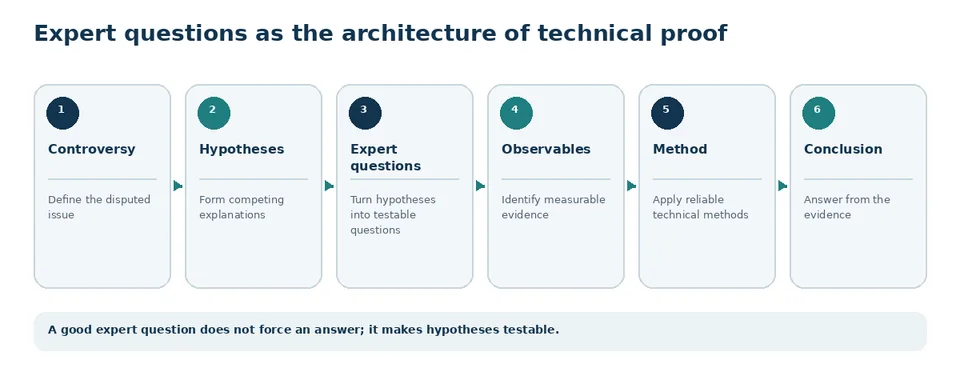
An engineering expert report rarely starts from a blank page. Its scope is shaped by the object of proof, the available documents, competing hypotheses and the questions presented to the expert.
Across expert-evidence systems, technical questions are used to define scope, test hypotheses and expose the basis of an opinion. Regardless of jurisdiction, robust reporting should make the object, methods, data sources, reasoning, findings and limitations transparent.[1]
The quality of the question therefore influences the quality of the answer.
2. A good question is not one that forces the desired conclusion
A question such as “Can the expert confirm that the defendant was negligent and caused the damage?” mixes technical causation with a legal characterization.
A better structure decomposes the problem:
what failure mode was observed?
which technical conditions could produce it?
do available records show overload, overvoltage, heating or other abnormal conditions?
did the installation meet applicable technical requirements?
is there evidence of maintenance, intervention or prior degradation?
which hypotheses are compatible or incompatible with the physical evidence?
The court decides legal responsibility; the expert clarifies technical facts.
3. Convert allegations into testable hypotheses
Suppose an electric motor failed after a network event. Possible hypotheses may include internal aging, external overvoltage, prolonged undervoltage/unbalance, mechanical overload, protection failure, poor maintenance or a combination.
Questions should seek evidence capable of discriminating among these hypotheses, rather than asking for a generic opinion.
4. Questions should point to observables
Strong technical questions are tied to measurable or verifiable items: measurements, records, documents, physical characteristics, design parameters, standards, tests, photographs, protection logs and maintenance history.
“Was the installation adequate?” is broad. Better questions address conductor sizing, protection, load, thermal evidence, maintenance and design criteria.
5. Standards must be contextualized in time and scope
Standards change. Their edition, applicability and purpose matter.
IEC 60364-1:2025 revised fundamental principles for low-voltage installations.[2] IEC 61000-4-30:2025 defines methods for power-quality measurements, including voltage magnitude, dips, swells, interruptions, transients, unbalance and harmonics.[3]
A forensic analysis should determine which standard applies to the installation, which edition was relevant at the time, whether local standards govern, and whether the cited requirement actually relates to the disputed mechanism.
A standards violation and technical causation are not automatically the same thing.
6. Questions about method are essential
International forensic-engineering reporting guidance emphasizes explicit methodology, the technical basis for opinions and clear communication of limitations.[1]
Appropriate questions may therefore address inspection method, instruments, calibration, measurement period, variables that could not be observed, standards used, uncertainty and limitations.
This is not an attack on the court expert. It is basic auditability.
7. A later inspection does not automatically recreate the past
Inspections often occur months or years after an event. Equipment may have been replaced, settings changed, load expanded or repairs performed.
The expert should distinguish present observation from retrospective inference and identify historical records needed to bridge that gap.
8. Causation questions should focus on mechanisms
Engineering causation should be supported by a physical or logical mechanism: thermal energy, arcing, insulation degradation, overvoltage, short-circuit current, mechanical failure, aging, contamination or installation error.
Useful questions include:
what known mechanisms can produce the observed damage?
what evidence would be expected under each mechanism?
which evidence is actually present?
what observations contradict a hypothesis?
can a primary cause be identified, or only contributing factors?
9. Missing data are themselves relevant
A scientifically responsible report does not fill evidentiary gaps with confidence.
A useful question may be: “Does the absence of records X and Y limit the ability to distinguish hypotheses A and B, and if so, how?”
This makes limitations explicit.
10. Supplemental questions: learning during the examination
Additional technical questions may become necessary as new facts emerge during an examination.[1] This is valuable because inspections can reveal unexpected conditions — replaced parts, different protection settings, new records or changes in configuration.
Technical assistance should update the hypothesis map as evidence evolves.
11. A pre-filing checklist
For every question, ask:
does it concern a technical fact?
is it sufficiently specific?
does it point to observable evidence?
does it distinguish hypotheses?
does it avoid legal conclusions?
does it avoid assuming unproven facts?
does it address method/uncertainty where relevant?
is it understandable to a non-engineer?
will the answer matter to the dispute?
12. The role of the technical assistant
A technical assistant can contribute before the formal examination by delimiting the technical object, mapping hypotheses, identifying missing documents, drafting questions, preparing inspections and anticipating limitations.
The earlier the technical issue is organized, the lower the risk of discovering after the report is filed that a decisive measurement was never taken or that a transient record expired.
13. Conclusion
Expert questions are an interface between legal language and technical investigation. Poor questions produce generic answers. Well-designed questions force the analysis to expose method, data, causation, limitations and competing hypotheses.
The most useful question is not the one that suggests the desired answer. It is the one that makes alternative explanations compete against the evidence.
In engineering disputes, identifying early what must be observed, measured and preserved may influence evidentiary quality more than lengthy argument after the report is already complete.
13A. Measurement quality
When an answer depends on measurement, a well-designed expert question may require instrument identification, range, resolution, calibration, traceability, test conditions, and relevant uncertainty. ISO/IEC 17025:2017 remains a current reference for competence and consistent laboratory operation, while the GUM received a 2026 amendment addressing nonlinearity in measurement models.
References
ASTM International. ASTM E3176-24 — Standard Guide for Forensic Engineering Expert Reports. https://store.astm.org/e3176-24.html
IEC.
IEC 60364-1:2025
. https://webstore.iec.ch/en/publication/63699
IEC.
IEC 61000-4-30:2025
. https://webstore.iec.ch/en/publication/71611
ISO.
ISO 31000:2018
. https://www.iso.org/standard/65694.html
NFPA.
NFPA 70B — Standard for Electrical Equipment Maintenance
, 2026 edition. https://link.nfpa.org/
ISO/IEC.
Guide 98-3:2008/Amd 1:2026 — Uncertainty of measurement — Amendment 1: Nonlinearity in measurement models
. https://www.iso.org/standard/92716.html
Editorial note: expert questions must be tailored to the scope actually defined in the case; there is no universal checklist that applies to every engineering examination.