Abstract
When equipment fails after an electrical disturbance, it is tempting to conclude that the preceding event caused the damage. Engineering requires more than temporal sequence. Causal analysis must identify a physically compatible mechanism and examine operational data, equipment characteristics, protection, maintenance, power quality and competing hypotheses. This article presents a forensic model that separates initiating event, failure mode, root cause, contributing factors and consequences, drawing on current installation, power-quality, maintenance and risk-management standards.
Keywords: failure analysis; power quality; equipment; root cause; electrical forensics.
1. “It happened before” does not mean “it caused”
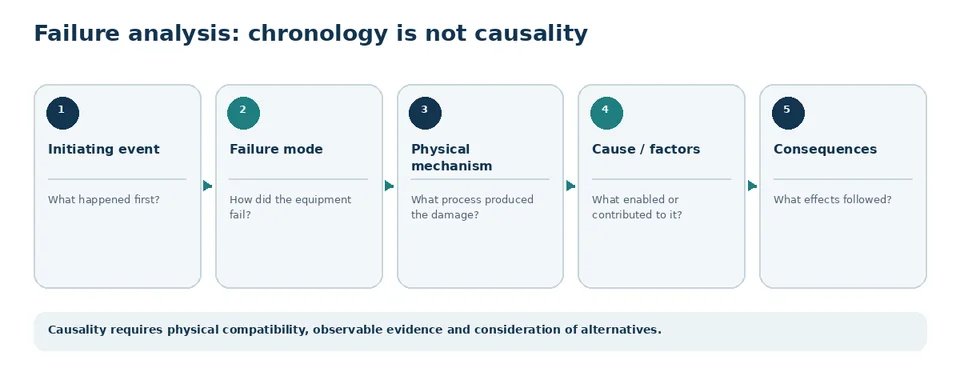
A motor that fails after a voltage disturbance may indeed have been damaged by that event. It may also have reached the end of prior thermal degradation, suffered mechanical overload, lost cooling, operated under unbalance or experienced insulation deterioration.
The expert must establish a causal mechanism, not merely a chronology.
A useful model separates initiating event, failure mode, physical mechanism, root cause, contributing factors and consequences.
2. Preserve the object before changing it
Before invasive testing, disassembly or disposal, the equipment and scene should be documented through photographs, labels, serial numbers, component positions, cables, terminals, thermal marks, arc evidence, protection settings, logs and replaced parts where relevant.
Altering the item too early can destroy evidence needed to discriminate among hypotheses.
3. Power quality must be characterized using an appropriate method
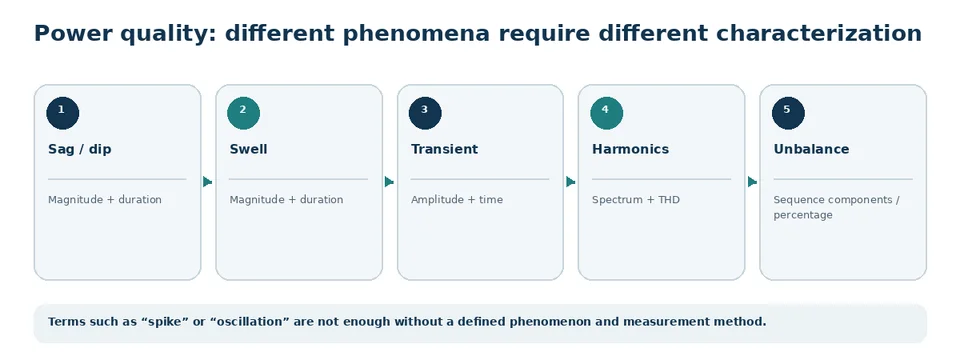
Terms such as “power spike” or “fluctuation” are technically vague.
IEC 61000-4-30:2025 defines measurement methods for power frequency, voltage magnitude, flicker, dips, swells, interruptions, transients, unbalance, harmonics and other parameters.[1]
The investigation should determine what phenomenon occurred, its magnitude and duration, how it was measured, instrument class, time synchronization and whether the record was contemporaneous.
4. Network event and damage must be physically compatible
If insulation failed, the examiner should determine whether the alleged event had sufficient magnitude, duration and coupling path to produce that failure mode.
This may require topology, voltage level, grounding, overcurrent protection, surge protection, coordination, impedance, load, insulation and environmental conditions.
IEC 60364-1:2025 provides updated fundamental principles for low-voltage installations.[2] Standards guide the analysis but do not replace causal reasoning.
5. A protection operation may be a consequence, not the cause
A tripped breaker or blown fuse does not necessarily indicate protection failure. An internal short may occur first, followed by increased current and correct protective operation.
In another case, poor settings may permit excessive fault energy and contribute to damage.
The sequence must be reconstructed from settings, curves, event records and physical evidence.
6. Maintenance is a causal variable
The condition of maintenance can materially affect failure probability.
NFPA 70B, 2026 edition, treats electrical-equipment maintenance through structured programs and condition assessment.[3]
Relevant evidence includes maintenance history, thermography, connection tightening, cleaning, insulation testing, lubrication, pending recommendations and monitoring alerts.
Lack of maintenance does not automatically prove causation, but it may constitute a contributing factor.
7. Latent degradation versus acute event
Many failures accumulate gradually until a smaller final event triggers breakdown: aged insulation, loose connections, deteriorated bearings, aged capacitors, contamination, moisture, thermal cycling or recurring harmonics.
The final event may be the trigger rather than the entire origin of the failure.
This distinction is important in liability, warranty and insurance disputes.
8. Historical data may be more valuable than a late inspection
SCADA logs, protective-relay oscillography, power-quality meters, inverters, UPS systems, maintenance databases, alarms and utility records can preserve contemporaneous evidence that a later site visit cannot reproduce.
These records should be identified early because retention may be limited.
9. Root cause should not be selected by informal elimination
Fault trees, 5 Whys, FMEA and hypothesis-based reasoning can structure investigation, but none replaces evidence.
A defensible process lists plausible hypotheses, defines expected evidence, collects observations, seeks contradictory data, evaluates interactions, classifies support and declares uncertainty.
ISO 31000 reinforces structured approaches to risk identification, analysis and evaluation.[4]
10. Non-compliance and causation are distinct questions
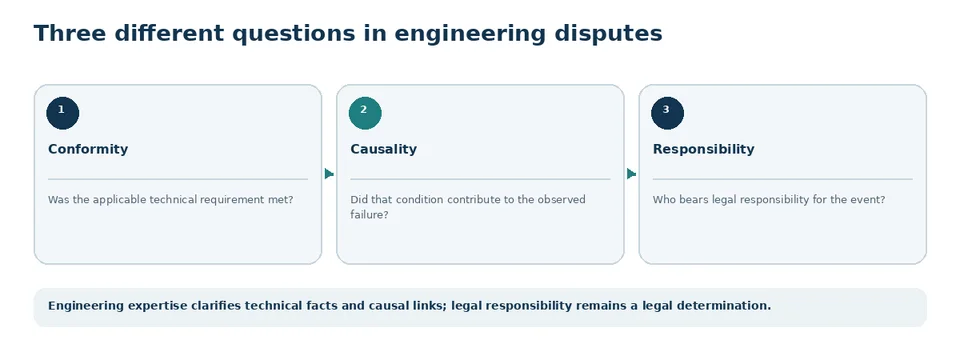
An installation may violate a standard without that violation causing the disputed damage. Conversely, a compliant installation may fail due to a defective component or exceptional external condition.
A report should separate:
compliance:
was the requirement met?
causation:
did the condition contribute to the observed failure?
11. Electronics and EMC
Modern equipment includes power electronics, communication and control, making electromagnetic compatibility increasingly relevant.
IEC 61000-5-6:2024 provides guidance on mitigation of external electromagnetic influences such as lightning and high-power transients.[5]
Some disputes may involve resets, communication loss or control failures rather than only visible physical damage.
12. Communicating probability and uncertainty
A report may responsibly state that a hypothesis is strongly supported, compatible but non-exclusive, a likely contributing factor, weakened by specific evidence, or indeterminate due to missing records.
Scientific honesty is preferable to selecting a single narrative solely because litigation seeks a simple answer.
13. Useful expert questions
What is the observed failure mode?
Which mechanisms can produce it?
Which evidence supports each mechanism?
Are contemporaneous records available?
What was the pre-event condition?
Did protection operate as expected?
Was there a technically relevant non-compliance?
Is that non-compliance causally connected to the damage?
What changed after the event?
Which limitations prevent a stronger conclusion?
14. Conclusion
Failure analysis is causal investigation. Chronology matters, but it is not enough. The examiner must demonstrate a technically plausible mechanism, compare it against physical evidence and records, and test alternatives.
Separating cause, consequence and contributing factor prevents two common errors: attributing all damage to the last observed event, or treating any non-compliance as automatic causation.
The strongest engineering opinion explains not only what failed, but why one mechanism better explains the available evidence and what uncertainties remain.
14A. Nonconformity, causation, and legal responsibility
Three layers should remain distinct: standards compliance, physical causation, and legal responsibility. Measurement uncertainty should also be compatible with the precision claimed. ISO/IEC 17025 and the GUM provide useful metrological references when test or measurement quality is material to the opinion.
References
IEC.
IEC 61000-4-30:2025
. https://webstore.iec.ch/en/publication/71611
IEC.
IEC 60364-1:2025
. https://webstore.iec.ch/en/publication/63699
NFPA.
NFPA 70B
, 2026 edition. https://link.nfpa.org/
ISO.
ISO 31000:2018
. https://www.iso.org/standard/65694.html
IEC.
IEC 61000-5-6:2024
. https://webstore.iec.ch/en/publication/69097
IEC.
IEC 61508-1:2010
. https://webstore.iec.ch/en/publication/5515
ISO/IEC.
ISO/IEC 17025:2017 — General requirements for the competence of testing and calibration laboratories
. https://www.iso.org/standard/66912.html
ISO/IEC.
Guide 98-3:2008/Amd 1:2026 — Uncertainty of measurement — Amendment 1: Nonlinearity in measurement models
. https://www.iso.org/standard/92716.html
Editorial note: applicable standards and methods depend on the installation, equipment, date of event and defined expert scope.