Abstract
Technical assistance is still often engaged only after a court expert has been appointed — or even after the report is filed. That is a reactive model. In technically complex disputes, decisions made before the examination can be irreversible: logs may expire, equipment may be repaired, key questions may not be asked and decisive measurements may never be performed. This article presents an early-engagement model in which the technical assistant helps define the technical object, map hypotheses, identify records, formulate questions and prepare evidence production without replacing legal strategy or the court expert’s role.
Keywords: technical assistant; expert evidence; questions; evidence preservation; complex litigation.
1. The reactive model leaves value on the table
Consider three engagement points:
before expert evidence is structured;
after the expert is appointed, to follow the examination;
after the report, to look for weaknesses.
The third can still produce useful methodological criticism, but it cannot recreate a deleted log, an unrepeated measurement or equipment that has already been repaired.
The more perishable the technical evidence, the greater the value of early involvement.
2. Technical participation should span the evidence lifecycle
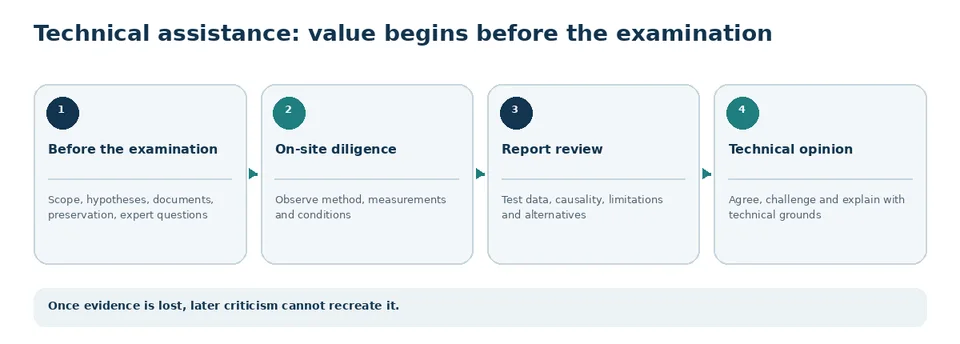
Across different dispute-resolution systems, technical experts may be engaged before, during and after a formal examination. Early participation helps define technical questions, preserve evidence, prepare inspections and evaluate expert findings; the exact procedural role depends on the applicable jurisdiction.[1]
It also allows the court, in appropriate circumstances, to dispense with a formal examination if technical opinions and documents sufficiently clarify factual issues.[1]
Specialized knowledge can therefore matter before, during and after the formal expert process.
3. Define the real technical problem before the examination
Legal narratives need to be translated into technical questions.
“Customer did not perform the transaction” becomes questions about authentication, device, recovery, logs, session linkage and behavioral changes.
“A network disturbance damaged equipment” becomes questions about the electrical event, contemporaneous measurements, failure mode, maintenance and protective operation.
This decomposition prevents the examination from starting with an overly abstract object.
4. Preserve before evidence disappears
Logs expire. Equipment is repaired. Configurations change. Cloud data are overwritten. Failed components are discarded.
ISO/IEC 27037 emphasizes identification, collection, acquisition and preservation of digital evidence.[2] NIST SP 800-86 provides a structured forensic workflow.[3]
A technical assistant can help legal counsel identify what should be preserved while legal counsel chooses the appropriate procedural instrument.
5. The right document matters more than document volume
Thousands of pages can still omit the decisive record.
Examples include authentication logs and device history in digital fraud; relay oscillography and maintenance in energy disputes; txids, withdrawal IDs and MFA records in crypto cases.
A preliminary technical analysis helps request specific information rather than hoping it appears later.
6. Build competing hypotheses
Technical assistance should not exist merely to “prove the client’s version.” A better model tests alternatives and asks what evidence would support or contradict each.
This improves expert questions and reduces confirmation bias.
7. Design questions before designing answers
Well-designed technical questions improve the quality of expert analysis because they force attention to method, sources, causation, standards, uncertainty and limitations.[1]
That is often one of the highest-value contributions an early technical assistant can make.
8. Prepare the inspection
Before an inspection or acquisition, a technical checklist can identify measurements, photographs, equipment IDs, calibration records, samples, logs, configuration states and post-event alterations that must be documented.
Without preparation, a site visit may generate many images while still missing the evidence that distinguishes the core hypotheses.
9. Accompanying the examination is not interference
A technical assistant can observe procedures, create a contemporaneous technical record, identify the need for supplemental questions and assess whether tests match the announced method — while respecting the court expert’s role and procedural boundaries.
10. Build a parallel technical record
After the inspection, contemporaneous notes about participants, instruments, measurements, documents, photographs and unresolved issues are valuable when the report arrives weeks or months later.
11. Review the report by method, not merely by outcome
The strongest critique is not “I disagree.” It shows why data, methodology or inference do not support a conclusion.
A structured review asks whether the object was answered, method was explicit, evidence sufficient, standards applicable, alternatives considered and limitations disclosed.
International expert-reporting guidance emphasizes a stated scope, transparent reasoning and an explicit technical method.[1]
12. A preliminary opinion may clarify whether a full examination is needed
In some disputes, a well-supported technical opinion and a complete documentary record can narrow the need for further physical examination. Whether such material is procedurally sufficient depends on the applicable jurisdiction.[1]
That does not make an opinion a universal replacement for court expert evidence; it shows that early technical work can clarify whether a formal examination is necessary and what its scope should be.
13. An early technical-assistance workflow
1 — Technical triage: understand facts, records and legal questions.
2 — Hypothesis map: translate narratives into technical possibilities.
3 — Evidence matrix: identify what exists, what is missing and what may disappear.
4 — Preservation strategy: provide technical input for counsel.
5 — Questions: formulate discriminating expert questions.
6 — Examination: prepare and accompany.
7 — Report review: test data, method and conclusions.
8 — Technical opinion: explain agreement or disagreement with technical reasoning.
14. Conclusion
A technical assistant creates less value when treated only as a post-report reviewer. The greater opportunity is to help ensure that the right evidence is produced in the first place.
In engineering, systems, digital fraud and blockchain disputes, data can be temporary and events cannot always be reproduced. The best time to think technically about expert evidence is before the examination begins.
Early technical work does not replace legal strategy. It supplies that strategy with better questions, better data and a clearer understanding of what can — and cannot — be demonstrated technically.
14A. Early technical assistance and role boundaries
Early technical assistance is most valuable when evidence is volatile. ISO/IEC 27042 emphasizes documented, reproducible analysis, and ISO/IEC 27043 provides incident-investigation process principles. The expert’s role should nevertheless remain distinct from legal strategy: the expert supplies technical hypotheses, evidence requirements, methods, and interpretation; counsel and the court retain legal characterization and decision-making.
References
ASTM International. ASTM E3176-24 — Standard Guide for Forensic Engineering Expert Reports. https://store.astm.org/e3176-24.html
ISO/IEC.
ISO/IEC 27037:2012
. https://www.iso.org/standard/44381.html
NIST.
SP 800-86
. https://doi.org/10.6028/NIST.SP.800-86
ASTM International. ASTM E620-18 — Standard Practice for Reporting Opinions of Scientific or Technical Experts. https://store.astm.org/e0620-18.html
ISO/IEC.
ISO/IEC 27042:2015 — Guidelines for the analysis and interpretation of digital evidence
. https://www.iso.org/standard/44406.html
ISO/IEC.
ISO/IEC 27043:2015 — Incident investigation principles and processes
. https://www.iso.org/standard/44407.html
Editorial note: legal strategy belongs to counsel; technical assistance provides specialized input on factual issues requiring scientific or engineering knowledge.